
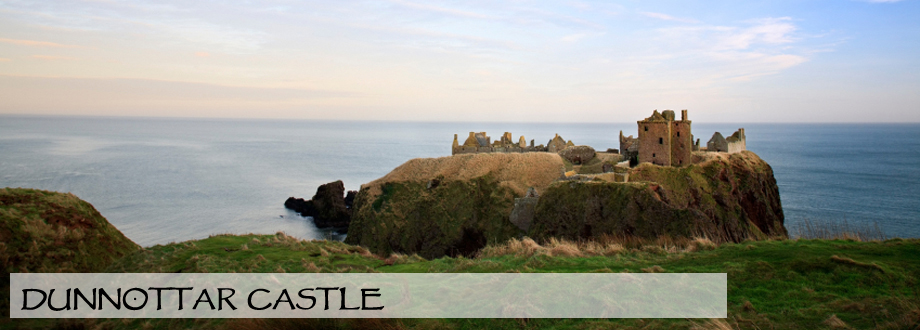
DUNNOTTAR CASTLE
In 1297 William Wallace burned alive an English Plantaganet garrison which was holding the castle. Much later, in 1562 and 1564, Mary Queen of Scots visited Dunnottar. The safe keeping of the Scottish Crown Regalia during the siege by Cromwell's Roundheads in 1650 is a famous historical event.
An event of a different kind occured in 1685, when 167 Covenanters were imprisoned in terrible conditions. The Whigs vault where these men and women were kept can be seen today as it was then. After the Rebellion of 1715, the property was fortified and soon fell into disrepair. Beginning in 1925, however, an ambitious programme of restoration was undertaken by the first Viscountess Cowdray. This work is responsible for the present state of the castle, now maintained by the Dunecht Estates.
Other places to visit in this NE region of Scotland include:
Aberdeen
'Granite City', whose speckled grey buildings overlook bustling fishing port and docks. Art gallery focuses on 18th to 20th-century painting and sculpture. Provost Skene's House, built 1545, has fine painted ceilings and local museum. Science and technology discovery centre.
Balmedie Beach
Shifting dunes border miles of sandy beach, safe for swimming, from River Ythan to River Don. A dozen burns trickle across sands, where birds and plants live.
Bridge of Dee
Graceful seven-arched bridge dates back 400 years. Scene of historic battle in the 17th century.
Brig o' Balgownie
Massive bridge, completed in 1329, spans 62ft in single arch. Bridge crosses deep pool of river and is backed by woods. Closed to motor vehicles.
Brimmond and Elrick Country Park
Park set in rolling countryside of hills and moorland. Guided and marked walks, and picnic area.
Broomend of Crichie
Bronze Age enclosure, over 100ft wide, with external bank and enclosed ditch. It surrounds central stone, a later addition, carved with Pictish symbols.
Camphill Village Trust
Community for people with special needs has workshops producing goods such as soft toys, furniture, metalwork and weaving. Shop sells wholemeal bread, cakes and coffee.
Catterline
White cottages perch on cliff tops descending steeply to a craggy bay. short walk along coast leads to Trelong Bay, where kittiwakes and fulmars nest in grass-covered cliffs. Remains of ancient church survive from 12th century.
Collieston
Grey-stone houses stand above caves once used by smugglers. Sheltered harbour supported thriving fishing industry. St Catharines Dub, a rocky headland, takes name from Spanish galleon wrecked there in 1594.
Cove Bay
Road from village approaches harbour set in cliffs. Fishing boats moor here and salmon nets are hung to dry.
Crombie Woollens Visitor Centre
Mill by River Don in Aberdeen has award-winning museum and visitor centre. Cloth, wool and ready-made clothes for sale. Fishing and riverside walks.
Cruickshank Botanic Gardens
Gardens have extensive collec-tions of shrubs, alpine plants, heather and succulents. Rock and water gardens.
Cullerlie
Bronze Age stone circle, 30ft across, with eight boulders around its circumference. Within circle are number of excavated burial chambers.
Downies
Rough road from village leads to cliff-top walk, where views look over to Cammachmore Bay. Steep path descends to rocky cove.
Drum Castle
Antique furniture and paintings enrich castle's interior. Home of Irvine family since 1323, its original keep adjoins Jacobean mansion, built 1619. Extensive grounds border old forest of Drum, where rhododendrons bloom beneath ancient oak and yew trees.
Dunnottar Castle
Steep path from beach climbs solitary rock, crowned by dramatic castle ruin. Cromwell's troops captured this Royalist stronghold after months of siege in 1652. Little-changed dungeon housed 167 covenanters in 1685.
Duthie Park
Park of 50 acres has floral displays in all seasons, including spectacular 'rose mountain'. Children's play area includes trampolines.
Dyce
Incised symbols and carved relief work cover two Pictish stones in St Fergus churchyard, to the north. Standing stone circle, 60ft in diameter, lies 2 miles west.
Findon
Good walk from village leads through fish-farm research station to two rocky coves, and on round cliffs to Portlethen village.
Fowlsheugh Nature Reserve
Two miles of cliffs echo with the calls of kittiwake and guillemot pairs that arrive for summer breeding season. Path to reserve leads from Crawton village.
Glenbervie
Robert Burns memorial cairn lies in scattered parish surrounded by wooded hills. Nearby churchyard holds ornate tombs.
Gordon Highlanders Regimental Museum
Museum has many relics of regiment, first raised by Duke of Gordon in 1794.
Haddo Country Park
Woodland walks span 180 acres rich with wild flowers and plants. Picnic areas and playground.
Haddo House
Fine gardens enclose mansion, designed by William Adam in 18th century for Earl of Aberdeen. Antique works of art, books and ceramics adorn rich interior. Nature trail skirts forest clearings, where roe deer graze.
Hallforest Castle
Ruin of powerful fortress dating from 14th century can be seen from road. Old residence of Keith family, Earls of Kintore.
Hazlehead Park
Largest park in Aberdeen, contains extensive woodland and well-tended rose, heather and azalea gardens. Children's corner has chickens, lambs and rabbits. Walk-in aviary. Adventure play-ground and bumper-car track. Impressive maze has over a mile of twisting paths.
Hill of Barra
Site of Battle of Barra fought between Robert Bruce and John Comyn in 1307. Comyn is thought to have camped in Pictish fort on hill. Fine views from hill over the Garioch basin.
Inverurie
Town museum displays local archaeological and geological finds, including arrowheads, stone axes and flint knives. In cemetery is SOft mound, the Bass, site of Norman castle. Brandsbutt Stone bears Pictish symbols. Seventeenth-century Scottish poet, Arthur Johnston, was born at Caskieben Castle -- now part of Keith Hall.
Kinkell Church
Ruin of parish church, built in 16th century, retains ornate details. Unusually designed sacrament house dates from 1524.
Kintore
External stone stairs enhance elegant town house, built 1737. Old bell chimes in house clock tower with original slate roof. Early Pictish stone stands in churchyard. Well-preserved Balbithan House lies in quiet dell to the north-east, across River Don.
Kirkton of Maryculter
Nursery rhyme and fairy-tale characters greet visitors, young and old, to make-believe garden world of Storybook Glen. Tropical palms and waterfalls enhance landscaped gardens.
Muchalls
Picturesque, white-painted village, dating from 19th century. To north, coast has spectacular rock formations including stacks and deep caverns.
Muchalls Castle
Fine plaster-work distinguishes Great Hall of 17th-century castle. Smugglers' tunnel, now blocked, once led to Gin Shore Cove.
Old Slains Castle
Ruined tower remains from Earl of Erroll's fortress, set above shingle beach. James VI had it destroyed in 1594 after learning of the Earl's plot to land Spanish troops on Scottish coast.
Pitmedden Garden
Formal gardens established in 1675 with central fountain, pavilions and sundials, all laid out in four great rectangles. Box hedges form elaborate designs and Latin mottoes. Museum of Farming Life includes furnished farmhouse.
Portlethen Village
Once-busy fishing village is now community for people employed in Aberdeen. Steep road leads to small cove, hemmed in by cliffs.
St Machar's Cathedral
Cathedral founded in 1131, though main part of building dates from 15th century. West front has twin towers. Painted wooden heraldic nave, dated 1520, is in use as parish church.
Stonehaven
New town, with amusement park and beach, dominates old town of fishermen's cottages by harbour. Local exhibits found in 16th-century Tolbooth Museum, where Episcopal clergymen were imprisoned in 1748. Panoramic view from war memorial on hill.
Tarves
Gothic and Renaissance styles evident in fine altar-tomb of William Forbes, resident of nearby Tolquhon Castle in 16th century. Tomb lies in Tarves parish church.
Tolquhon Castle
Impressive, pink sandstone castle ruins, set in wooded glen. Large quadrangular mansion, built by William Forbes adjoins keep, dating from 15th century, called Preston Tower. Two round towers with grated windows stand beside remains of gate-house with ornate gunports.
Tolquhon Gallery
Work of Scottish artists, including prints, paintings, ceramics and glass, exhibited in changing programme. Sculptures are displayed in garden.
Udny Green
Above village is Udny Castle, tower house dating from 14th century, crowned by ornamental turrets. Churchyard has stone and slate 'morthouse', built 3832, to protect unburied dead from clutches of resurrectionists.
ABERDEENSHIRE
» Arbroath
» Ballater & Balmoral
» Banff & Buchan
» Caerlaverock Castle
» Callander
» Castle Sween
» Claypotts Castle
» Dornoch
» Drum Castle
» Dunbeath Castle
» Dunnottar Castle
» Dunstaffnage Castle
» Edzell Castle
» Glamis Castle
» Inchture
» Kirriemuir
» Montrose & Strathmore
» Nithsdale