
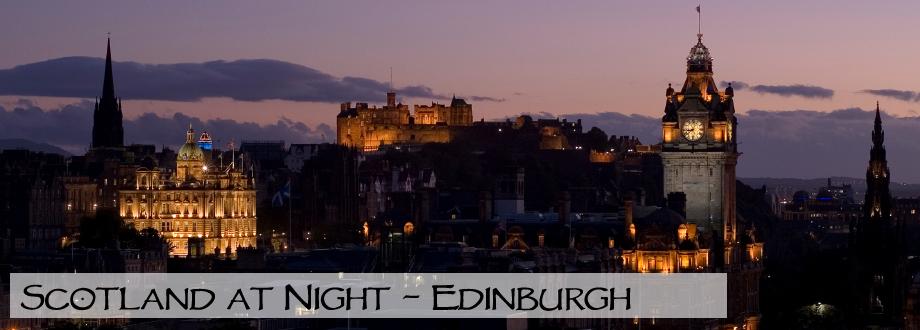
EDINBURGH
Brass Rubbing Centre
Collection of replicas moulded from ancient Pictish stones, rare Scottish brasses and medieval church brasses, with facilities for making rubbings.
Calton Hill
A collection of monuments mark 350ft hill, with magnificent views of castle and Arthur's Seat. Part reproduction of Parthenon, and replica of Lysicrates' monument show why city is known as 'Athens of the North'. Nearby stand City Observatory and mon-uments to Bums and Nelson.
Camera Obscura
Observation tower near castle, with panoramic views of city. Guide tells story of Edinburgh while visitors watch revolving image of city.
Canongate Kirk
Restored 17th-century church, built by order of James VII to serve parishioners of Canongate, Palace of Holyroodhouse and Edinburgh Castle. Buried in the churchyard are economist Adam Smith and 18th-century poet Robert Fergusson.
Canongate Tolbooth
Has served as a courthouse and prison since it was built in 1591. Building now houses The Pee pie's Story -- an exhibition which illustrates the life and works of Edinburgh citizens, from late 18th century to present day. Also includes restored prison cell.
Chambers Street
The Heriot-Watt University, founded in 1854, stands among buildings of the University of Edinburgh, founded 1582. Robert Adam designed impressive 'Old College' in 1789.
City Art Centre
Converted warehouse with four floors of changing exhibitions and displays from the city's collection of paintings.
Edinburgh Castle
Home of Scottish kings and queens from centuries past, dominating the city from its perch of volcanic rock. The Scottish Crown jewels are kept in the Old Royal Palace, where Mary, Queen of Scots gave birth to future King James VI of Scotland, James I of England. Within castle walls are National War Memorial, 13ft long Mons Meg cannon and the city's oldest building -- 12th-century St Margaret's chapel.
Edinburgh Dungeon
An eerie atmosphere is evoked with sounds, smells and settings based on Scotland's history in the 'Historical Torture Museum'.
Edinburgh University Collection of Historic Musical Instruments
More than 1000 items including around 350 woodwind instruments, 250 stringed and 150 brass. Also percussion and bagpipes.
Floral Clock
Oldest in the world, built 1903 in Princes Street Gardens. Almost l2 ft in diameter and filled with 230,000 flowers.
Georgian House
A selection of rooms furnished as they might have been during the city's 'Golden Age' in 1796. China, silver and furniture. Bathroom with mahogany and brass lavatory. House lies in elegantly designed Charlotte Square, which dates from late 18th century.
Gladstone's Land
Early 17th-century six-storey tenement, with main floors restored as typical home of the period. Contains remarkable painted ceilings. Copies of 17th-century goods in replica shop booth.
Greyfriars Kirk
Site of the signing of the National Covenant in 1638, rejecting Anglicanism and asserting Scotland's right to decide its own destiny. Outside is a statue of 'Greyfriars Bobby'; famous Skye terrier who watched over his master's grave in the kirkyard for 14 years.
Holyrood Abbey
Picturesque ruins uf Chapel Royal of Holyroodhouse, founded in 1128 by King David I. Old vault contains the remains of several Scottish monarchs.
Huntly House Museum
Principal museum of local history, housed in a restored 16th-century town mansion. Includes National Covenant of 1638 and collections of Edinburgh silver and glass.
John Knox House
Museum in house with numerous gables, outside stair and elaborate carvings, dating from 15th century. Associated with John Knox, Scotland's religious reformer, and James Mossman, goldsmith to Mary, Queen of Scots. Gold-smith's workshop and Knox's library with 'preaching window', from which he is said to have addressed crowds below.
Lady Stair's House
Museum devoted to Scotland's greatest literary figures: Robert Burns, Sir Walter Scott and Robert Louis Stevenson. Includes portraits, relics and manuscripts.
Magdalen Chapel
One of the city's oldest surviving buildings, dating from the 16th century, notable for its stained-glass windows. Now serves as chapel of Heriot-Watt University.
Mercat Cross
Restored cross, containing part of the 14th-century original, is still the appointed place for royal proclamations. Here in 1513 crowds heard of the death of James IV at Flodden Field.
Museum of Childhood
Fun-filled museum devoted solely to the history of childhood. Vast collection of historic toys, dolls, games, books and costumes.
National Gallery of Scotland
Unrivalled collection of Scottish paintings. Also has masterpieces from the Renaissance to 20th century, by artists such as Raphael, Rembrandt and Van Gogh.
National Monument
Twelve Doric pillars, modelled on the Parthenon, commemorating Scottish dead in the Napoleonic Wars. Intended to be a church, but funds dried up two years after work started in 1824.
Nelson Monument
Built 1815, lO6 ft high, with magnificent views over city and Firth of Forth from parapets. Naval flags are flown each year on October 21 to commemorate Nelson's victory and death at the battle of Trafalgar.
North Bridge
Built across the chasm formed when the Nor' Loch was drained in 1760, it divides the Old and New towns. The current cast-iron bridge dates from the 1890s.
Old Tolbooth
Heart-shaped pattern of cobble-stones set in pavement, marks site of vanished 15th-century prison, demolished in 1817. It provided the opening scene in Sir Walter Scott's famous romantic novel Heart of Midlothian.
Palace of Holyroodhouse
The official Scottish residence of the Queen dates from the late 15th century, but was reconstructed for Charles II in the 17th century. Mary, Queen of Scots came here in 1561 and stayed for six tragic years. State apartments house tapestries, paintings and furniture, and the picture gallery has portraits of 89 Scottish kings. Adjoining palace is Holyrood Park, rich in animal and plant life.
Parliament House
Built 1632-9, seat of the Scottish government until Union with England in 1707. Now the supreme law courts of Scotland. Parliament Hall is a Gothic chamber, 120ft long, with a fine hammerbeam roof and portraits by Raeburn. Statue of Sir Walter Scott stands beside library.
Princes Street
Scotland's greatest thoroughfare, built in 1805, famous for its shops, public buildings and spectacular panorama of the Old Town and castle. its south side is flanked by fine gardens. At one end is the Scott Monument.
Regimental Museum of The Royal Scots
Bursting with memorabilia of the British Army's most senior Regular Regiment, formed in 1633. Displays include silver, weapons, medals and campaign relics.
Register House
Robert Adams building, designed in 1722, has Scottish National archives from the 12th century.
Scott Monument
Marble statue of novelist Sir Walter Scott.
St. Giles Cathedral
The High Kirk of Edinburgh with its famous spire.
And much, much, more………….
SOUTH SCOTLAND
» Galloway
» Argyll
» Ayrshire
» Glasgow
» Loch Lomond
» Lothian Region
» Edinburgh
» Southern Scotland Accommodation